#include <context.h>
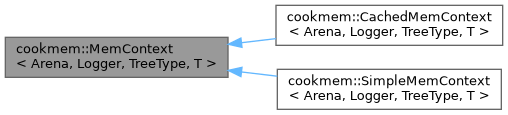
Public Types | |
| typedef MemContext< Arena, Logger, TreeType, T > | MemCtx |
| typedef MemPool< Arena, Logger, TreeType, T > | Pool |
| typedef Pool::size_type | size_type |
| typedef Pool::difference_type | difference_type |
| typedef Pool::value_type | value_type |
| typedef Pool::pointer | pointer |
| typedef Pool::const_pointer | const_pointer |
Detailed Description
class cookmem::MemContext< Arena, Logger, TreeType, T >
A basic memory context that creates a MemPool based on the arena and logger references user passed in.
This class is mostly used in cases when arena or logger that do not have default constructors.
Member Typedef Documentation
◆ const_pointer
const pointer type
◆ difference_type
pointer difference type
◆ MemCtx
| typedef MemContext<Arena, Logger, TreeType, T> cookmem::MemContext< Arena, Logger, TreeType, T >::MemCtx |
The type of this memory context.
◆ pointer
◆ Pool
The type of the memory pool that does the actual work.
◆ size_type
| typedef Pool::size_type cookmem::MemContext< Arena, Logger, TreeType, T >::size_type |
size type
◆ value_type
Constructor & Destructor Documentation
◆ MemContext() [1/2]
|
inline |
Constructor.
- Parameters
-
arena the arena to obtain memory segments from. It must outlive this context. logger the logger for memory activities. It must outlive this context. paddingSize the number of padding bytes (0 to MAX_PADDING_SIZE) added after each allocation to detect out-of-bounds writes.
◆ MemContext() [2/2]
Create a new, empty memory context that shares the arena and the logger of another context and uses the same padding size. No memory is copied.
- Parameters
-
other the context whose arena and logger are shared.
Member Function Documentation
◆ allocate()
Allocate memory from the memory context.
- Parameters
-
size memory request size.
- Returns
- the memory region that is at least the request size. nullptr if the request cannot be satisfied.
◆ allocateAligned()
|
inline |
Allocate memory with an alignment larger than ALLOCATION_ALIGNMENT.
The memory is freed with deallocate () like any other allocation. reallocate () does not keep the alignment if it moves the memory.
- Parameters
-
size memory request size. alignment the alignment of the returned pointer. It must be a power of - An alignment up to ALLOCATION_ALIGNMENT is the same as allocate ().
- Returns
- the memory region that is at least the request size and is aligned to the alignment. nullptr if the alignment is not a power of 2, or if the request cannot be satisfied.
◆ callocate()
|
inline |
Allocate n items of certain size. The memory allocated is zeroed.
- Parameters
-
num number of elements size element size
- Returns
- memory allocated. nullptr if num * size overflows, or if the request cannot be satisfied.
◆ contains()
|
inline |
Check if a pointer is within the address space of segments owned by this MemPool.
- Parameters
-
ptr memory pointer checkUsed check the pointer if it is used.
- Returns
- whether the memory address is in the space of segments owned by this MemPool. If checkUsed is true, the result is true only if the pointer is also marked as used.
◆ deallocate()
|
inline |
Free a piece of memory previously allocated by this memory pool.
- Parameters
-
ptr a piece of memory to be freed. size mostly ignored. It is only used by the memory logger.
◆ getArena()
Get the underlying memory arena.
- Returns
- The underlying memory arena.
◆ getFootprint()
Get the current memory footprint.
- Returns
- the current memory footprint.
◆ getFootprintLimit()
Get the memory footprint limit.
- Returns
- the memory footprint limit
◆ getImmediateReleaseThreshold()
|
inline |
Get the size at which freed allocations release their memory right away.
- Returns
- the allocation size in bytes. 0 means disabled.
◆ getLogger()
Get the underlying logger.
- Returns
- The underlying logger.
◆ getMaxFootprint()
Get the maximum memory footprint.
- Returns
- the maximum memory footprint.
◆ getPaddingByte()
|
inline |
Get the padding byte.
- Returns
- The padding byte.
◆ getPaddingSize()
|
inline |
Get the number of padding bytes checked after each allocation.
◆ getPool()
Get the underlying memory pool.
- Returns
- The underlying memory pool.
◆ getSize()
Gets the allocated size for a pointer.
If we are storing the exact size of the pointer, then the result can match the exact size of user's allocation.
Otherwise, the result is the aligned size.
- Parameters
-
ptr A pointer.
- Returns
- the allocation size. if the pointer is nullptr, the result is 0. if the pointer is not used, the result is 0.
◆ getTrimEmptySegmentsInterval()
|
inline |
Get the number of deallocations between empty-segment trimming passes.
◆ isPadding()
Check whether or not we are padding bytes at the end of the allocated memory.
- Returns
- whether or not we are padding bytes at the end of the allocated memory.
◆ isStoringExactSize()
Check whether or not we are storing the exact user size in the memory.
- Returns
- whether or not we are storing the exact user size in the memory.
◆ reallocate()
|
inline |
This function reallocate a memory.
- Parameters
-
ptr the current memory pointer. size the new size
- Returns
- the reallocated pointer. If the new size cannot be satisfied, a nullptr is returned and the old pointer remains valid.
◆ releaseAll()
Release all the memory segments held by this MemPool.
◆ releaseAllToSystem()
Release all the memory segments held by this MemPool, then the segments cached by the arena, so that the memory is returned to the system. Every pointer allocated from this context becomes invalid.
Unlike releaseAll (), this also empties the cache of a CachedArena, including the segments that other contexts sharing the arena could have reused.
◆ setFootprintLimit()
|
inline |
Set the maximum memory footprint limit. Allocations that would need new memory segments beyond this limit fail and return nullptr.
- Parameters
-
footprintLimit the maximum total size of the memory segments in bytes. 0 means no limit.
◆ setImmediateReleaseThreshold()
|
inline |
Set the size at which freed allocations release their memory right away.
A large allocation usually gets a segment of its own. When an allocation at least this large is freed and its segment becomes entirely free, the segment is released to the arena immediately, instead of at the next empty-segment trimming pass.
- Parameters
-
threshold the allocation size in bytes. The default is DEFAULT_IMMEDIATE_RELEASE_THRESHOLD. 0 disables the immediate release.
◆ setPaddingByte()
|
inline |
Set the padding byte.
- Parameters
-
paddingByte The padding byte.
◆ setStoringExactSize()
Set whether or not we should be storing the exact user size in memory.
- Parameters
-
b the boolean choice
◆ setTrimEmptySegmentsInterval()
|
inline |
Set the number of deallocations between empty-segment trimming passes.
Memory segments that become entirely free are kept for later allocations. After every interval deallocations, the segments that are entirely free are released to the arena. A smaller interval keeps the footprint smaller, but releases and obtains segments more often.
- Parameters
-
interval the number of deallocations between the passes. The default is DEFAULT_TRIM_EMPTY_SEGMENTS_INTERVAL. 1 (or 0) releases empty segments on every deallocation.
◆ validate()
Validate the internal memory structures.
The documentation for this class was generated from the following file: